When utility engineers speak about transformer reliability, the conversation often begins with the transformer itself: core design, winding configuration, cooling system, and insulation structure. Yet one of the most underestimated stages in the life of a high-voltage asset is what happens to the insulating oil before it ever enters the tank. Even new transformer oil is not automatically “grid-ready.” During refining, drum storage, international transport, drum transfer, and site handling, the fluid can pick up trace moisture, dissolved air, fine particulate matter, and occasional atmospheric contamination. For this reason, the modern commissioning workflow treats oil conditioning as a separate discipline, not as a formality. This is where the vacuum transformer oil purifier becomes indispensable.
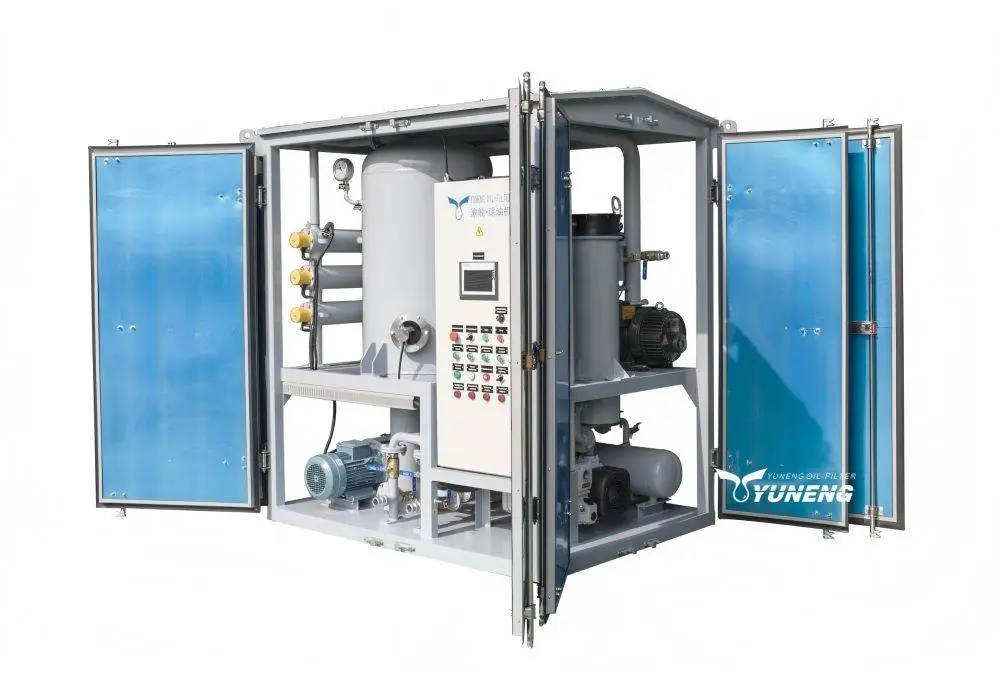
The YUNENG ZJA3 3000LPH unit illustrates the engineering logic clearly. It is described as a double-stage high-vacuum system built for dehydration, degasification, and fine filtration of insulating oil. In practice, that means the oil is drawn into a controlled low-pressure environment where dissolved water flashes off far more efficiently than under atmospheric conditions, while entrained gases are evacuated and suspended solids are captured through precision filtration. The published treatment targets—breakdown voltage restored to high levels, water content driven down to around 5 ppm, gas content minimized, and filtration accuracy in the micron range—are not marketing abstractions. They correspond to the real commissioning requirement that new oil should enter the transformer in a dry, clean, electrically stable state.
A useful way to understand the value of this stage is to look at transformer oil regeneration vs purification in the context of a brand-new asset. For new or only physically contaminated oil, the dominant problem is not chemical decay; it is moisture, particles, and air. A vacuum transformer oil purifier answers that problem directly. A transformer oil regeneration machine, by contrast, is normally justified when aged oil carries polar oxidation by-products, organic acids, darkening color, or sludge precursors. Using regeneration on fresh oil would be technically possible in a broader plant, but conceptually unnecessary: the oil has not yet developed the chemically bonded contaminants that adsorption media exist to remove. Purification here is the correct first movement.
The 3000 LPH class also solves a practical site issue. Many substations, indoor switchgear basements, retrofit projects, and renewable installations do not have generous space or unlimited auxiliary power. A compact, mobile purifier with swivel casters or a towable envelope can be moved between several distribution transformers, capacitor banks, or circuit-breaker installations. Because the same equipment can act as a vacuum filling and drying partner, the operator can pull a vacuum on the transformer tank, help remove moisture from paper and winding insulation, and then inject polished oil directly into that vacuum boundary. This sequence reduces the re-contamination window that ordinary top-up methods leave open.
Read in parallel with the YZS regeneration literature, the story becomes coherent rather than contradictory. A modern maintenance fleet may own both technologies: the vacuum transformer oil purifier for commissioning, periodic moisture control, post-leak recovery, and preventive circulation; the transformer oil regeneration machine for the later chapter in the asset cycle when acid number begins to climb. The mistake is not choosing one over the other permanently—it is misunderstanding which physical or chemical problem is being solved. For the pre-commissioning engineer, the objective is unambiguous: deliver dry, degassed, particle-controlled oil into a dry tank, and let the first energization occur with the dielectric margin the design assumed.
Seen this way, the 3000 LPH vacuum purifier is not a ancillary accessory. It is part of the foundational quality chain: sample, analyze, pre-treat, vacuum-condition, fill under vacuum, seal, and verify. When that chain is respected, the transformer begins life with cleaner insulation, better heat transfer through the oil path, and a measurable reduction in early moisture-related risk.